
Member Acquisition Strategies: How Do Associations Attract and Retain New Members?

Growing your association means more than keeping current members engaged—it requires attracting new ones. Without consistent member acquisition, even the most successful organizations can face membership decline as members retire or move on.
The urgency is clear: According to the 2025 Membership Marketing Benchmarking Report, 45% of associations reported membership growth last year, while 26% experienced declines. To thrive, associations must prioritize both acquisition and retention with clear strategies.
This guide will walk you through practical member acquisition strategies—from clarifying your value proposition to building community engagement to appealing to the next generation of members (Millennials and Gen Z). By exploring these strategies, you can grow, retain, and sustain membership for the long term.
Understand Your Target Audience
Before diving into tactics, get the foundation right:
- Define your ideal member persona(s). Use surveys, interviews, and market research to understand demographics, motivations, and challenges.
- Segment your audiences. If you serve multiple groups, tailor outreach with personalized messaging.
- Share proof points. Use testimonials, case studies, or success stories to demonstrate impact and credibility.
Related reading: Download the 2024 Association Member Experience Report to learn what matters most to association members.
Define (or Refine) Your Value Proposition
You also have to understand and be able to clearly communicate your association’s unique selling points. This is where many associations struggle. The 2025 MGI report found that only 11% of associations consider their value proposition “very compelling,” while nearly two-thirds of executives (63%) say prospects don’t join because they don’t understand the value.
Member acquisition is about convincing potential members of the value of your member benefits and organization.
- Pinpoint your unique strengths, be it your expertise, resources, or exclusive opportunities. By highlighting these unique qualities, you can captivate potential members.
- Think about what your association offers, and how it ties back to your audience’s needs and motivations. Ask yourself if there are any trending benefits you’re missing or any gaps. For example, Smithbucklin’s recent report on Perceptions and the Evolving Role of Associations found that professional development and certification and accreditation are some of the top member benefits, particularly for early career professionals.
- Collect testimonials or success stories from current members to help understand what members value most and build trust and credibility.
- Consider how to clearly express the ways your organization adds value to potential members’ lives or businesses. Whether it’s access to industry insights, networking opportunities, or professional development resources, you need to be able to explain the tangible benefits potential members can gain by joining your organization.
Your value proposition should be compelling and concise. The language you use shouldn’t be overly promotional. Instead, think of your messaging as providing the information someone needs to understand how your association will meet their needs and solve their challenges.
Remember to put things in terms of the value you provide to members – lead with outcomes, not features. Below, we’ve outlined some examples of language shifts:
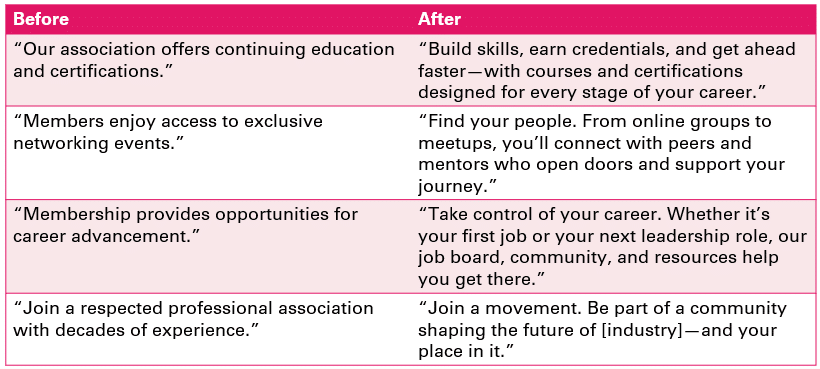
Member Acquisition Strategies
With a firm understanding of your association’s audience and value proposition, now you’re ready to apply member acquisition strategies to attract new members. Here are 5 strategies to attract new members:

1. Leverage Your Existing Members
Your members are your best ambassadors. Encourage them to bring others into the fold:
- Referral programs: Incentivize current members to refer others, offering rewards such as discounts, exclusive access to content or events, or referral bonuses. Make sure the tracking for referral programs is user-friendly and intuitive, and that you communicate incentives clearly and consistently to encourage participation.
- “Bring a Friend” events: Encourage current members to invite their friends or colleagues to a special “get acquainted” meetup. Maintain an informal and non-salesy tone and showcase everything the association does in an approachable way.
- Celebrate member wins: Showcase your most active members in your newsletters or through awards programs. Many of your members know a network of people who are not yet part of your association. When you celebrate your members’ milestones or offer the opportunity to win an award, they will likely share their wins with their peers (or their friends will share it for them!). Not only will your existing member enjoy the recognition, but their friends and peers will enjoy the opportunity to celebrate them – and may be impressed the association gives its members this kind of exposure.
2. Strengthen Your Online Presence
The Perceptions and the Evolving Role of Associations found that the primary obstacle to members joining your association is lack of awareness. A strong digital footprint ensures prospective members can find—and trust—you. By optimizing your website for search engines and AI/LLMs, creating valuable content, and utilizing social media and online platforms, you can increase your visibility and potential members will come to you.
- Optimize your website and enhance SEO. Ensure it’s mobile-friendly and easy to navigate. Conduct keyword research and incorporate member-focused keywords into your website’s content, meta tags, and headings. This enhances your website’s visibility in search engine results and attracts organic traffic (i.e. more people visiting your website and learning about membership). Your content (online community discussions, blog posts, resources, articles, job postings on your job board, community conversations, etc.) help you attract more traffic and members too! Position yourself as an industry leader and establish credibility with your target audience.
- Implement an AI-ready content structure. Write in clear, conversational formats that AI can easily summarize. Use FAQs, numbered lists, and structured headers. Include concise definitions, “how-to” steps, and comparisons. Questions are increasingly what AI assistants surface. Example: Instead of “continuing education program,” use “how [professionals] can earn credentials in [field].”
- Create high-value content. Publish blogs, resources, and job board listings that demonstrate thought leadership.
- Use social media intentionally. More than 65% of associations use organic social media for recruitment—but don’t just post updates; share insights, celebrate members, offer resources, and create engaging media that sparks conversation.
- Explore video and audio. YouTube is the #2 search engine after Google, and (for now) it still brings more website traffic than AI chatbots. Consider developing short video explainers (1–3 minutes) on career paths, networking tips, or industry trends. Be sure to optimize descriptions, titles thumbnails, and format for searchability. You might also consider sharing clips from popular webinars on YouTube or launching a podcast to extend your reach.
Related listening: Listen to our podcast episode with Higher Logic advisor, Romeo Talento, on SEO quick wins.
3. Let Prospects Sample the Member Experience
Exclusivity is powerful, but a taste of your community can be the best sales pitch. Some associations run into an issue where they give too much away for free and there’s no reason for non-members to “upgrade” to a paid membership. But others have the opposite problem. If absolutely everything you offer is locked down to members only, it can make it hard for potential members to decide whether your association is right for them.
Not to mention, your member benefits will often speak for themselves if you give someone a sample!
- Open your online community. Do you let non-members join your online community or post on your community job board? Cracking the door open to non-members is actually a great way to get your own foot in their door. If non-members can create a community account and engage in some of your community discussions, they get to see the community culture that makes your association great – and YOU get access to their contact information to follow-up with them. (Higher Logic Thrive Community’s logged-out homepage is a great way to share highlights).
- Offer free trials or test drives. Provide short-term access to benefits so prospects experience the value firsthand. Today’s users are used to freemium models in which they get to experience an app, service, platform before committing to a subscription. Eliminate a prospect’s doubt by letting them experience (for a set period of time) exactly what it’s like to be a member. Don’t be stingy either. Give them access to the full range of member benefits and give it to them for a long enough period (say, a month) that they get hooked and don’t want to be without it.
- Run special promotions. Conference and convention discounts are the most common recruitment incentive, used by 52% of associations, followed by introductory dues for students/young professionals (32%) and first-year discounts (28%). While you want to avoid devaluing membership by cutting dues too deeply, think about offering an introductory rate for newcomers. This can even be done during special, limited membership drives. And while you’re at it, you can offer the occasional “membership appreciation” discount to existing members to lock up retention.
4. Meet Potential Members Where They Are
Today’s members expect personalization. Show them you understand their needs.
- Segmented email campaigns: Tailor outreach to interests and engagement history.
- Communication preferences: Respect how often and where prospects want to connect.
- Personalized messaging: Replace generic outreach with meaningful, one-to-one communication.
How Can Associations Appeal to Younger Generations Like Millennials and Gen Z?
Generational shifts are reshaping associations. According to the 2025 Membership Marketing Benchmarking Report, Millennials now make up 25% of memberships, while Gen Z accounts for 11%. And according to both the US Bureau of Labor Statistics and Purdue Global, by 2031, these two generations will represent more than 70% of the workforce. Associations that adapt to their expectations will secure long-term growth, while those that don’t risk membership decline.
- Understand Their Core Motivators: money, meaning, and well-being. These generations seek financial stability in uncertain economies. But 90% say purpose-driven work is also critical for well-being. And speaking of well-being, work-life balance, flexible schedules, and hybrid opportunities are non-negotiables.
- Embrace Digital-Native Expectations: prioritize mobile-first experiences, seamless websites, easy-to-use event apps, and online communities. Make sure onboarding is easy and the member experience is frictionless (with things like integration, single sign-on, and intuitive navigation).
- Communicate clearly and casually: Use authentic, concise, and visual communication. Focus on outcomes, not features. Share peer voices and member stories — they trust peers over institutions
- Design Learning That Fits Their Style: 77% of Gen Z and 78% of Millennials prefer video-based learning. They also seek out microlearning, stackable LinkedIn-badge-friendly certifications and micro-courses.
- Create Community and Belonging: Prioritize exclusive, sharable experiences. Leverage online communities (especially those like Higher Logic Thrive Community that mimic the social platforms they already use) to reinforce their belonging in the industry. Think about ways to get them more involved with early leadership opportunities (e.g. committees, ambassador roles, and content creation).
Learn more in our dedicated blog post.
5. Partner with Like-Minded Organizations
It’s easier to accomplish something with help. Strategic collaboration can expand your reach and credibility. Partnering with other organizations in your industry presents an opportunity to cross-promote organizational benefits to each other’s audiences. It’s a great, and often mutually beneficial way to expand your reach and attract new members.
- Co-host events: Collaborating on joint events, webinars, or conferences can showcase the collective expertise and offerings of both organizations, making membership more appealing to prospective members. Make these events accessible to non-members and provide existing members with the opportunities
- Cross-promote resources: Share research or content with aligned organizations.
- Form alliances: Strengthen your position in the industry by partnering with associations serving complementary audiences. Whether it’s trading content assets, co-sponsoring a webinar, or sharing resources, both parties can bring what they do best to the table. Sharing resources like research findings, industry insights, or educational materials can also enhance the value proposition for potential members and foster a sense of community among industry peers.

Lessons from the Field: What We Learned in a Recent Webinar
On a recent Higher Logic-partner webinar with iMIS Users Group Asia Pacific, association experts Beth Arritt and Devin Timbrook surfaced several key insights about why member acquisition and retention succeed (or fail):
- Value must be clear. Associations often list features (career centers, events, certifications) but fail to explain why they matter—leaving prospects unconvinced.
- Onboarding is critical. Engaging members immediately (and continuously) ensures they experience value before renewal. One association built an 18-month onboarding program to reinforce value long after sign-up.
- Personalization drives growth. Using data, engagement scoring, and web tracking allows associations to respond with timely, relevant communications—at AAAE, this helped grow membership from 4,000 to 7,000 individuals.
- Members aren’t ATMs. Engagement shouldn’t always equal an ask. Highlight benefits members already have—like communities and included resources—to build goodwill and loyalty.
Don’t Stop with Acquisition – Keep Members Coming Back
Acquisition is only half the equation—retention sustains your growth.
- Deliver continuous value. The MGI report found that the median renewal rate remains stable at 84%, but the renewal rate for first-year members is significantly lower at 75%, making onboarding critical.
- Celebrate loyalty. Recognize anniversaries, milestones, and contributions.
- Collect and act on feedback. Lack of engagement is the top reason members don’t renew.
- Measure success. Track metrics like acquisition rate, retention rate, and engagement to refine strategies.
Conclusion
Member acquisition isn’t about a single tactic—it’s about creating an ecosystem where your value is clear, your audience is aware of your organization, your existing members are engaged, and prospective members feel welcomed. By combining referrals, strong digital presence, trial experiences, generational engagement, personalized outreach, and strategic partnerships with a commitment to retention, your association can thrive in today’s competitive environment.
Next Step: See how Higher Logic Thrive can help your association attract and retain members through community, marketing automation, and engagement solutions.
Related Resources

Recruit, Retain, and Engage: Strategies for a Thriving Membership Base
Learn strategies for recruiting, retaining, and engaging members while tackling common challenges. This webinar shares actionable insights to boost satisfaction,...
Read More
Association Job Boards Power Engagement, Member Value, and Revenue
Explore the huge positive impact of having an association job board – both for engaging current members and prospective members.
Read More
SEO Quick Wins for Associations: A Practical Guide
Search Engine Optimization (SEO) might sound daunting, but we’ve got some quick wins you can use if you’re a small...
Read More